
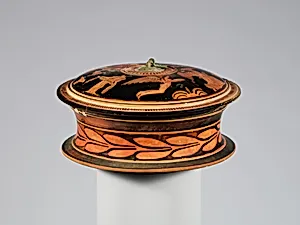
Terracotta pyxis (box)
Unknown Artist
late 5th century BCE
Medium
Terracotta
Dimensions
H. 3 in. (7.6 cm)
Classification
Vases
Culture & Period
Greek, Attic · Classical
Department
Greek and Roman Art
Museum
Metropolitan Museum of Art, New York, NY
Credit
Rogers Fund, 1906
Accession Number
06.1021.120a, b
Rights
Public Domain
Tags
Art Historical Context
This exquisite terracotta pyxis or small lidded box, hails from late 5th-century BCE Attic Greece during the Classical period—a golden age of Athenian culture following the Persian Wars. Standing just 3 inches (7.6 cm) tall, these intimate vessels were crafted for everyday luxury, often holding cosmetics, jewelry, or ointments for women. Produced in Athens' renowned pottery workshops, the pyxis exemplifies the era's mastery of wheel-thrown terracotta, fired to a warm red hue that served as the canvas for intricate painted scenes. Adorned with depictions of women and Eros, the god of love, its decoration likely captures mythological or daily vignettes of beauty, courtship, and desire—themes central to Greek ideals of femininity and romance. Attic artists employed the red-figure technique, reserving the natural clay color for figures while incising details and painting backgrounds black with slip. This innovation allowed for finer anatomical precision and expressive gestures, marking a pinnacle of vase-painting artistry before its decline. Today, housed in the Metropolitan Museum of Art's Greek and Roman Art Department (acquired via the Rogers Fund in 1906), this pyxis offers a tangible glimpse into Classical women's worlds, blending utility, artistry, and cultural reverence for the sensual.