
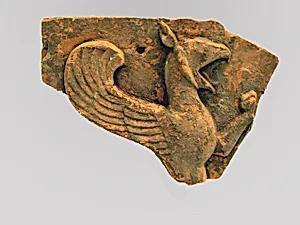
Terracotta revetment with a griffin
Unknown Artist
6th century BCE
Medium
Terracotta
Dimensions
Overall: 7 1/2 x 10 x 1 3/4in. (19.1 x 25.4 x 4.4cm)
Classification
Terracottas
Culture & Period
East Greek or Lydian · Archaic
Department
Greek and Roman Art
Museum
Metropolitan Museum of Art, New York, NY
Credit
Gift of Gordian Weber, 2000
Accession Number
2000.305.1
Rights
Public Domain
Tags
Art Historical Context
This striking terracotta revetment plaque, featuring a majestic griffin, dates to the 6th century BCE during the Archaic period.ed by an unknown East Greek or Lydian, it once adorned the walls or roofs of a grand building, serving as protective architectural decoration. Measuring just 7½ x 10 x 1¾ inches, its modest size belies its role in larger friezes, where such plaques created vibrant, narrative displays. Griffins—hybrid creatures with the body of a lion and the head and wings of an eagle—were potent symbols of power and guardianship in ancient cultures, blending Greek mythology with Near Eastern influences from Lydia in Anatolia. The use of terracotta, a fired clay medium favored for its durability and affordability, allowed for intricate molding techniques that captured the griffin's fierce gaze and dynamic pose. This piece highlights the cultural exchanges across the eastern Mediterranean, where Ionian Greeks and Lydians fused artistic traditions. A generous gift to the Metropolitan Museum of Art in 2000, this artifact invites us to imagine the opulent temples and palaces it once embellished, whispering tales of ancient myths and masterful craftsmanship. (198 words)