
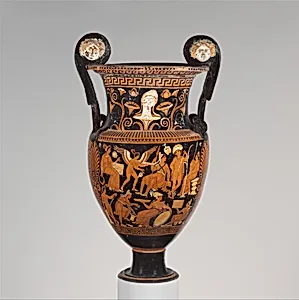
Terracotta volute-krater (mixing bowl)
ca. 330–310 BCE
Medium
Terracotta
Dimensions
H. with handles 30 5/16 in. (77 cm); H. to rim 26 3/4 in. (68 cm)
Classification
Vases
Culture & Period
Greek, South Italian, Apulian · Late Classical
Department
Greek and Roman Art
Museum
Metropolitan Museum of Art, New York, NY
Credit
Purchase, Mrs. James J. Rorimer Gift, 1969
Accession Number
69.11.7
Rights
Public Domain
Tags
Art Historical Context
This striking terracotta volute-krater, created around 330–310 BCE by the Baltimore Painter, exemplifies the rich artistic traditions of South Italian Greek colonies in Apulia during the Late Classical period. As a large mixing bowl used to blend wine and water at symposia or rituals, its impressive scale—over 30 inches tall with its distinctive spiral volute handles—highlights both its practical role and its status as a ceremonial object. Produced in the Greek settlements of southern Italy, such vessels blended Athenian influences with local tastes, reflecting cultural exchange across the Mediterranean. The Baltimore Painter, named for a similar krater now in Baltimore, was a master of Apulian red-figure technique, employing fluid lines and added white and color to enliven mythological scenes. The krater’s imagery, featuring women, Eros, Hermes, and male nudes, likely depicts divine or heroic narratives popular in funerary or celebratory contexts. These details underscore the vessel’s dual function as both utilitarian ware and a canvas for storytelling that connected daily life with the divine. Today housed in the Metropolitan Museum of Art’s Greek and Roman collection, this krater offers visitors a vivid glimpse into the sophisticated world of ancient Apulian artisans and their enduring fascination with myth and form.
About the Artist
Baltimore Painter
**The Baltimore Painter** was a prolific and highly influential Apulian vase painter active in South Italy during the final quarter of the fourth century BCE, roughly 330–310 BCE. As one of the last major figures in the Apulian red-figure tradition, he is widely regarded as the most important Late Apulian vase painter. His conventional name derives from a prominent volute krater now in the Walters...