
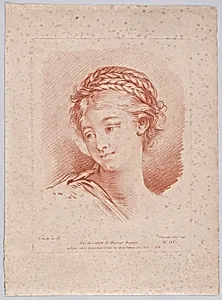
Tête de femme
18th century
Medium
Crayon-manner etching printed in red ink
Dimensions
Image: 9 3/16 × 7 7/16 in. (23.3 × 18.9 cm) Plate: 11 1/4 × 8 1/4 in. (28.5 × 21 cm) Sheet: 15 5/16 × 11 1/4 in. (38.9 × 28.6 cm)
Classification
Prints
Department
Drawings and Prints
Museum
Metropolitan Museum of Art, New York, NY
Credit
Gift of Fritz S. Hofheimer, 1959
Accession Number
59.628.1
Rights
Public Domain
Tags
Art Historical Context
In the opulent world of 18th-century French Roc art, *Tête de femme* the graceful allure of a woman's head, created as a crayon-manner etching engraver Gilles Demarteau after a design by François Boucher.oucher, the celebrated court painter to Louis XV, was renowned for his elegant, sensual depictions of women often infused with mythological charm and soft, flowing lines. Demarteau, a master reproductive printmaker, faithfully translated Boucher's into print, allowing this intimate portrait study to reach a broader audience beyond elite collectors. The standout feature is the crayon-manner technique, pioneered in mid-18th-century France to mimic the textured strokes of chalk or pastel drawings. Printed in vivid red ink—known as *crayon rouge*—it evokes the warmth of sanguine chalk, blending etching's precision with a painterly softness. Measuring about 9 by 7 inches in its image area, this print exemplifies how such innovations democratized high art, bridging the gap between original sketches and affordable multiples. Housed in the Metropolitan Museum of Art's Drawings and Prints department (gift of Fritz S. Hofheimer, 1959), *Tête de femme* reflects Rococo's celebration of beauty and femininity, offering visitors a window into an era of lavish indulgence and technical ingenuity.
About the Artist
Gilles Demarteau|François Boucher · 1729–1776
Gilles Demarteau the Elder, born on January 19, 1722, in Liège, began his career steeped in the craft of metalwork. The son of a gunsmith, he learned engraving and goldsmithing from his father before moving to Paris around 1748–1750 to join his brother, who worked as a goldsmith for the engraver De Lacollombe, renowned for firearm ornament designs. Demarteau trained in De Lacollombe's workshop as ...