
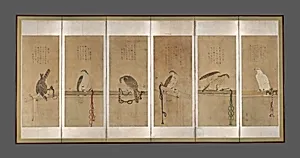
曽我直庵筆 架鷹図押絵貼屏風|Tethered Hawks
before 1606
Medium
Twelve paintings mounted as a pair of six-panel folding screens; ink and color on paper
Dimensions
Overall (each screen incl. frame): 68 3/8 in. × 11 ft. 10 3/8 in. (173.7 × 361.7 cm) Image (outer two panels, each screen): 48 1/2 × 19 5/8 in. (123.2 × 49.8 cm) Image (inner four panels, each screen): 48 1/2 × 20 1/2 in. (123.2 × 52.1 cm)
Classification
Paintings
Culture & Period
Japan · Momoyama period (1573–1615)
Department
Asian Art
Museum
Metropolitan Museum of Art, New York, NY
Credit
Purchase, Mary and James G. Wallach Foundation Gift, 2018
Accession Number
2018.449.1, .2
Rights
Public Domain
Tags
Art Historical Context
Behold the striking *Tethered Hawks*, pair of six-panel folding attributed to Soga Chokuan (also known as Itt Jōteki or Shōteki), created before 1606 during Japan's vibrant Momoyama period (3–1615). Comprising twelve individual paintings in ink and color on paper these screens exemplify the era's bold decorative arts, where opulent screens adorned the residences of samurai lords and nobility. Measuring over 11 feet wide when open, they would have transformed interiors into immersive landscapes, showcasing the artist's skill in capturing the poised intensity of tethered hawks. Hawks held profound cultural symbolism in feudal Japan, representing nobility, keen vision, and the thrill of falconry—a favored pastime among the warrior elite. This motif reflects the Momoyama taste for dynamic, naturalistic subjects rendered with vivid colors and fluid ink lines, mounted in the traditional *okuziebari* style (押絵貼り), where paintings are pasted onto the screen surface for a seamless, jewel-like effect. Such screens were not mere decoration but status symbols, evoking power and refinement. Today, this masterpiece graces the Metropolitan Museum of Art's Asian Art collection, a testament to the enduring allure of Momoyama elegance. Visitors can marvel at how these hawks seem ready to soar, bridging art and aristocratic life across centuries.