
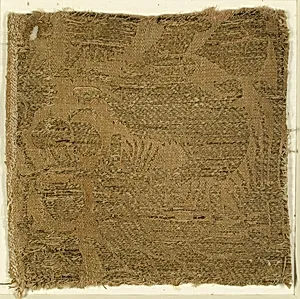
Textile, Brocade
Unknown Artist
15th century
Medium
Satin, gold thread
Dimensions
Overall: 4 1/2 × 4 11/16 in. (11.5 × 11.9 cm) Storage (Mat): 8 1/2 × 13 in. (21.6 × 33 cm)
Classification
Textiles-Woven-Brocade
Culture
Italian
Department
Medieval Art
Museum
Metropolitan Museum of Art, New York, NY
Credit
Rogers Fund, 1909
Accession Number
09.50.1000
Rights
Public Domain
Art Historical Context
This exquisite 15th-century Italian bro textile, a small fragment measuring just 4½ × 4⅞ inches, showcases the opulence of Renaissance-era weaving. Housed in the Metropolitan Museum of Art's Medieval Department (acquired through the Rogers Fund in 9), it exemplifies the luxurious textiles produced in Italy's renowned weaving centers, where silk satins were elevated with shimmering gold threads to create designs that caught the light like jewelry. Brocade technique involves a supplementary weft—here, intricate gold threads woven over a satin ground—to form raised, embossed patterns, lending a three-dimensional richness. This labor-intensive method required skilled artisans and costly materials, making such pieces symbols of wealth and prestige. Likely used for ecclesiastical vestments, noble garments, or sumptuous furnishings, it reflects Italy's dominance in the medieval luxury trade, blending Eastern silk influences with Western innovation. Though the specific motifs are not detailed in surviving records, this fragment invites us to imagine vibrant patterns of florals or geometrics, evoking the splendor of 15th-century courts and cathedrals—a testament to craftsmanship that transcended utility to become wearable art.