
Textile with Brocade
Unknown Artist
14th century
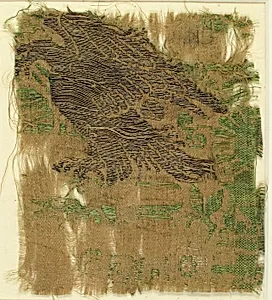
Medium
Silk, gold thread
Dimensions
Overall: 5 3/8 × 4 3/4 in. (13.7 × 12 cm) Storage (Mat): 8 1/2 × 13 in. (21.6 × 33 cm)
Classification
Textiles-Woven-Brocade
Culture
Italo-Arabic
Department
Medieval Art
Museum
Metropolitan Museum of Art, New York, NY
Credit
Rogers Fund, 1909
Accession Number
09.50.999
Rights
Public Domain
Art Historical Context
This exquisite *Textile with Brocade from the 14th century exemplifies the luxurious fusion of Italo-Arabic craftsmanship during the medieval period. Crafted from shimmering silk woven with opulent gold thread, this fragment—measuring just 5 3/8 × 4 3/4 inches—likely originated from workshops in Sicily or southern Italy, where Norman rulers blended Islamic weaving traditions with European tastes. Acquired through the Rogers Fund in 1909, it now graces the Medieval Art department at the Metropolitan Museum of Art a testament to vibrant cross-cultural exchanges along Mediterranean trade routes. Brocade, the textile's classification, is a sophisticated weaving technique where supplementary gold wefts create raised, metallic motifs against the silk ground, catching light to evoke splendor. Such pieces were prized for ecclesiastical vestments, aristocratic garments, and interior furnishings, symbolizing wealth and piety in a era of expanding commerce between Europe, the Byzantine Empire, and the Islamic world. The Italo-Arabic style often featured intricate geometric or floral patterns, reflecting shared aesthetic influences. Though the artist remains unknown, this fragment invites us to marvel at the anonymous skill of medieval artisans. Its survival highlights the fragility and rarity of these treasures, offering a tangible glimpse into a world where silk roads wove cultures together.