
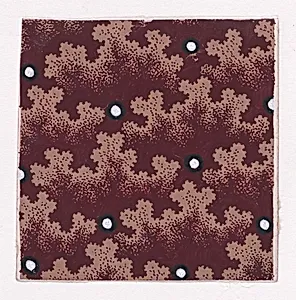
Textile Design with Alternating Vertical and Horizontal Rows of Pearls Over a Background of Alternating Horizontal Garlands of Abstract Bushes
Medium
Gouache
Dimensions
Sheet: 2 3/16 × 2 3/16 in. (5.5 × 5.5 cm)
Classification
Drawings|Ornament & Architecture
Department
Drawings and Prints
Museum
Metropolitan Museum of Art, New York, NY
Credit
Museum Accession, transferred from the Library
Accession Number
1978.671.5(25.2)
Rights
Public Domain
Art Historical Context
This charming gouache design from 1840 offers a glimpse into the world of 19th-century Alsatian textile production. Created by an anonymous artist from the Als region of France, the tiny square sheet—measuring just 2 /16 inches on each side—presents a carefully balanced pattern of alternating vertical and horizontal rows of pearls. These are set against a rhythmic background of horizontal garlands formed by stylized, abstract bushes, creating a lively yet orderly surface ideal for fabric printing or weaving. Gouache, with its opaque and luminous qualities, was a favored medium for such ornamental studies, allowing designers to preview how colors and motifs would appear on cloth. As part of the Metropolitan Museum’s Drawings and Prints collection, this work belongs to the broader tradition of ornament and architecture designs that supported Europe’s growing textile industry during the Industrial Revolution. Though modest in scale, the piece reflects the era’s emphasis on decorative innovation, where anonymous artisans contributed patterns that brought elegance to everyday clothing and household goods.
About the Artist
Anonymous, Alsatian, 19th century · 1800–1900
**The artist known as Anonymous, Alsatian, 19th century** remains unidentified by name, with no documented details of birth, family, training, or personal life. All known works are attributed solely through their style, medium, and provenance to an Alsatian creator active in the mid-19th century, particularly around 1840 in Mulhouse (then a key hub of textile manufacturing in the Haut-Rhin region ...