
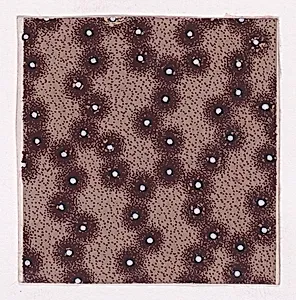
Textile Design with an Interlacing Pattern of Circles with Pearls over a Stippled Background
Medium
Gouache
Dimensions
Sheet: 2 3/8 × 2 5/16 in. (6 × 5.9 cm)
Classification
Drawings|Ornament & Architecture
Department
Drawings and Prints
Museum
Metropolitan Museum of Art, New York, NY
Credit
Museum Accession, transferred from the Library
Accession Number
1978.671.5(24.9)
Rights
Public Domain
Art Historical Context
This delicate gouache textile design from 1840, created by an anonymous Alsatian, showcases an intricate interlacing pattern of circles adorned with pearls against a finely stippled background. Measuring just 2 3/8 × 2 5/16 inches, its miniature scale belies its precision, typical of pattern samples intended for textile production during the early Industrial Revolution. Housed in the Metropolitan Museum of Art Drawings and Prints department, it exemplifies 19th-century ornamentation blending geometric elegance with luxurious motifs. Alsace, straddling French and German influences, was a hub for innovative textile manufacturing in the 1800s, and this piece reflects that vibrant tradition. Gouache, an opaque watercolor medium prized for its vibrant colors and smooth application, allowed designers to render detailed prototypes that could be scaled up for weaving or printing on fabrics like silk or cotton. The pearl-like embellishments evoke opulence, hinting at high-end fashion or home furnishings for an emerging middle class. As a snapshot of ornamental architecture in design, this anonymous work highlights the unsung artistry behind everyday luxury. Its stippled texture mimics woven fabrics, bridging the gap between drawing and manufacture—a testament to the era's fusion of craft and industry.
About the Artist
Anonymous, Alsatian, 19th century · 1800–1900
**The artist known as Anonymous, Alsatian, 19th century** remains unidentified by name, with no documented details of birth, family, training, or personal life. All known works are attributed solely through their style, medium, and provenance to an Alsatian creator active in the mid-19th century, particularly around 1840 in Mulhouse (then a key hub of textile manufacturing in the Haut-Rhin region ...