
Textile Fragment
Unknown Artist
3rd–4th century
Medium
Wool, linen; plain weave, tapestry weave
Dimensions
H. 13 11/16 in. (34.7 cm) W. 6 1/8 in. (15.5 cm)
Classification
Textiles
Department
Islamic Art
Museum
Metropolitan Museum of Art, New York, NY
Credit
Purchase by subscription, 1889
Accession Number
89.18.26
Rights
Public Domain
Art Historical Context
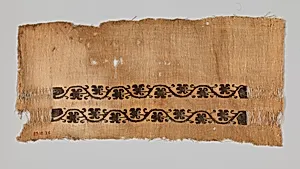
This delicate textile fragment, dating to the 3rd–4th century, offers a tantalizing glimpse into the artistry of Late Antique weaving from the Near East or eastern Mediterranean. Crafted from wool and linen using plain weave for the sturdy ground fabric and tapestry weave for decorative elements, it measures just 13 11/16 by 6 1/8 inches—small enough to have adorned a garment, cushion, or curtain in daily life. Acquired by the Metropolitan Museum of Art through subscription purchase in 1889 it resides in the Islamic Art department, highlighting the enduring legacy of pre-Islamic textile traditions that influenced later Islamic designs. The combination of plain and tapestry weaves was a sophisticated technique of the era, allowing weavers to create vibrant, pictorial motifs directly in the cloth without additional embroidery. Wool provided warmth and colorfast dyes, while linen offered breathability, making these textiles practical yet luxurious for both elite and everyday use. Such fragments, often surviving from mummy wrappings or buried goods in arid regions like Egypt, reveal advanced dyeing and patterning skills that bridged Roman, Byzantine, and early Sasanian worlds. Today, this unassuming piece underscores the cultural richness of early Islamic art's roots, preserving techniques that evolved into the opulent carpets and robes of later centuries. A quiet testament to anonymous artisans, it invites us to imagine the hands that wove it amid bustling ancient markets.