
Textile Fragment
Unknown Artist
3rd–4th century
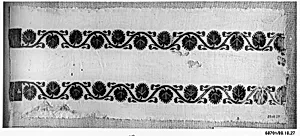
Medium
Wool, linen; plain weave, tapestry weave
Dimensions
H. 12 3/4 in. (32.4 cm) W. 6 5/16 in. (16 cm)
Classification
Textiles
Department
Islamic Art
Museum
Metropolitan Museum of Art, New York, NY
Credit
Purchase by subscription, 1889
Accession Number
89.18.27
Rights
Public Domain
Art Historical Context
This delicate Textile Fragment, dating to the 3rd–4th, offers a glimpse into the sophisticated textile traditions of the ancient Near East or Egypt, regions later central to Islamic art. Crafted from wool and linen plain weave for the foundation and tapestry weave for decorative elements, it exemplifies early techniques that combined durability with vibrant patterning. At just 12¾ × 6⅜ inches (32.4 × 16 cm), this small survivor hints at larger garments or furnishings, preserved through the arid conditions of its origin. The use of tapestry weave—where colored weft threads are woven directly into the ground fabric—allowed artisans to create intricate designs without additional sewing, a method prized for its efficiency and colorfastness. Such fragments, acquired by the Metropolitan Museum of Art through subscription purchase in 1889, reflect the height of Late Antique textile production, bridging pre-Islamic and early Islamic eras. They showcase how everyday materials like wool (for warmth and dye absorption) and linen (for strength) supported cultural exchanges along trade routes. Displayed in the Museum's Islamic Art Department, this piece underscores the continuity of artistic excellence in textile arts, where motifs likely included geometric or figural patterns symbolizing status or protection. A testament to anonymous craftsmanship, it invites us to marvel at the skilled hands behind history's quiet luxuries.