
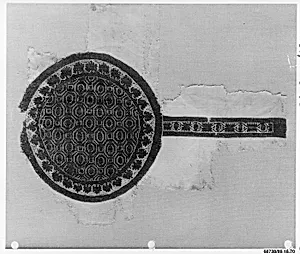
Textile Fragment
Unknown Artist
3rd–4th century
Medium
Wool, linen; plain weave, tapestry weave
Dimensions
H. 19 11/16 in. (50 cm) W. 11 7/8 in. (30.2 cm)
Classification
Textiles
Department
Islamic Art
Museum
Metropolitan Museum of Art, New York, NY
Credit
Purchase by subscription, 1889
Accession Number
89.18.70
Rights
Public Domain
Art Historical Context
This exquisite textile fragment, dating to the 3rd–4th century, offers a glimpse into the sophisticated weaving traditions of the early Islamic world—or more precisely, the late antique period in regions that would shape Islamic art. Crafted from wool and linen, it measures 19 11/16 by 11 7/8 inches (50 by 30.2 cm) and survives as a precious remnant, likely from a garment, curtain, or furnishing. Acquired by the Metropolitan Museum of in 1889 through public subscription, it resides in the museum's Islamic Art department, the enduring legacy of these ancient crafts. The fragment showcases a masterful combination of techniques: a plain weave forms the sturdy ground cloth, while tapestry weave creates vibrant, discontinuous patterns—a labor-intensive method where colored weft threads are woven directly into the fabric to form motifs without floating yarns. This approach, common in antiquity, allowed for bold, durable designs that withstood daily use, reflecting the technical prowess of weavers in centers like Egypt or the Near East. Culturally, such textiles were vital to daily life and trade, bridging Byzantine, Sassanian, and emerging Islamic influences. Though details of its imagery are not specified, fragments like this reveal a world where art was functional yet beautifully ornate, preserving stories of craftsmanship across millennia for us to admire today.