
Textile Fragment
Unknown Artist
3rd–4th century
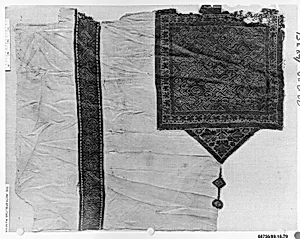
Medium
Wool, linen; plain weave, tapestry weave
Dimensions
H. 22 3/16 in. (56.4 cm) W. 18 1/8 in. (46 cm)
Classification
Textiles
Department
Islamic Art
Museum
Metropolitan Museum of Art, New York, NY
Credit
Purchase by subscription, 1889
Accession Number
89.18.79
Rights
Public Domain
Art Historical Context
This exquisite Textile Fragment, dating to the 3rd–4th century, offers a rare glimpse into the artistry of Late Antique textile production, likely from Egypt, as preserved in the Metropolitan Museum of Art's Islamic Art collection Crafted from wool and linen using plain weave for the foundation and tapestry weave for decorative elements, it exemplifies the technical sophistication of ancient weavers. Acquired through a subscription purchase in 1889 this fragment measures 22 3/16 by 18 1/8 inches, a testament to the durability of these materials over 1,700 years. Tapestry weave, where colored weft threads are woven directly into the warp to create patterns, allowed for vibrant, pictorial designs without painting or dyeing the entire cloth—a labor-intensive technique that highlights the weavers' skill and the value of textiles in daily life and trade. Such fragments often featured motifs like animals, figures, or geometric patterns, reflecting cultural exchanges along Mediterranean routes. In the context of Islamic Art, this piece bridges pre-Islamic and early Islamic traditions, underscoring the continuity of textile arts in regions like Egypt. Surviving examples are precious, as organic materials rarely endure, making this a window into ancient craftsmanship and the woven stories of the past.