
Textile Fragment
Unknown Artist
3rd–4th century
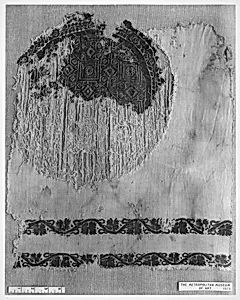
Medium
Wool, linen; plain weave, tapestry weave
Dimensions
Max. H. 20 1/16 in. (51 cm) Max. W. 16 15/16 in. (43 cm)
Classification
Textiles
Department
Islamic Art
Museum
Metropolitan Museum of Art, New York, NY
Credit
Purchase by subscription, 1889
Accession Number
89.18.83
Rights
Public Domain
Art Historical Context
This exquisite *Textile Fragment* from 3rd–4th century offers a glimpse the sophisticated textile traditions of antiquity. Crafted from wool and linen—two of the most enduring fibers of the ancient world—it measures about 20 by 17 inches, preserving a portion of what was likely a larger garment, hanging, or furnishing. Acquired by the Metropolitan Museum of Art 1889 through public subscription, it resides in the Department of Islamic Art, highlighting the cultural continuities between pre-Islamic and later Islamic textile arts in regions like Egypt or the Near East. The fragment showcases masterful weaving techniques: a plain weave for the sturdy ground fabric, combined with tapestry weave for colorful, pictorial inserts. Tapestry weaving, where wefts are discontinuous and packed tightly to create patterns without a visible ground, was a labor-intensive method prized for its durability and vivid designs. Though the specific motifs are not detailed here, such textiles often featured geometric motifs, animals, or figures, reflecting daily life, mythology, or early Christian iconography in a multicultural Mediterranean world. As a rare survivor from over 1,600 years ago, this piece underscores the artistic ingenuity of anonymous makers whose work influenced Byzantine, Coptic, and eventually Islamic decorative arts. It invites us to marvel at how everyday crafts carried profound cultural stories across centuries.