
Textile Fragment
Unknown Artist
3rd–4th century
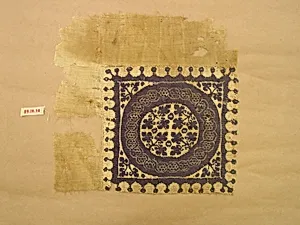
Medium
Wool, linen; plain weave, tapestry weave
Dimensions
Max. H. 5 5/16 in. (13.5 cm) Max. W. 5 7/8 in. (15 cm)
Classification
Textiles
Department
Islamic Art
Museum
Metropolitan Museum of Art, New York, NY
Credit
Purchase by subscription, 1889
Accession Number
89.18.98
Rights
Public Domain
Art Historical Context
This delicate **Textile Fragment**, dating to the 3rd–4th century, offers a tantalizing glimpse into ancient weaving traditions from the Near East or Egypt, now preserved in the Metropolitan Museum of Art's of Islamic Art. Craft from wool and linen—a practical combination for durability and comfort—this small piece (just 5 5/16 by 5 7/8 inches) survives as a rare testament to everyday artistry in the Late Antique period, acquired through a subscription purchase in 1889. The fragment showcases two key techniques: **plain weave**, a simple over-under interlacing of warp and weft threads that forms a sturdy foundation, and **tapestry weave**, where discontinuous colored wefts are woven into the ground to create vibrant patterns or motifs. Tapestry weave, known since antiquity, allowed artisans to produce detailed designs without painting or dyeing the entire cloth, making it ideal for decorative panels, garments, or furnishings. As a humble survivor of time and use, this fragment highlights the sophisticated textile production that flourished across cultures, influencing later Islamic traditions. Though its exact motifs are faded, it evokes the skilled hands of anonymous weavers whose work bridged ancient worlds.