
Textile Fragment
Unknown Artist
3rd–4th century
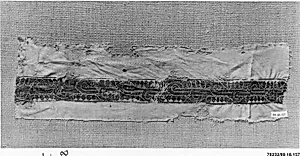
Medium
Wool, linen; plain weave, tapestry weave
Dimensions
H. 4 in. (10.2 cm) W. 15 3/4 in. (40 cm)
Classification
Textiles
Department
Islamic Art
Museum
Metropolitan Museum of Art, New York, NY
Credit
Purchase by subscription, 1889
Accession Number
89.18.157
Rights
Public Domain
Art Historical Context
This delicate textile fragment, dating to the 3rd–4th century, offers a glimpse into the sophisticated weaving traditions of the ancient Near East or Egypt, regions central to early Islamic cultural heritage. Crafted from wool and linen—staple fibers of the era—it measures a modest 4 by 15¾ inches, yet survives as testament to everyday artistry in a time of Roman and Byzantine influence. Acquired by the Metropolitan Museum of Art 1889 through public subscription, it resides in the Islamic Art department highlighting the continuity of textile production across pre-Islamic and Islamic eras. The fragment employs a plain weave for its sturdy ground cloth, overlaid with tapestry weave—a technique where colored weft yarns are woven discontinuously to create vibrant patterns without waste. This method, labor-intensive and precise, allowed weavers to produce intricate motifs efficiently, often for garments, furnishings, or burial wrappings. Wool provided durability and warmth, while linen added a crisp texture, reflecting practical adaptations to local climates and trade networks. Such fragments are invaluable for understanding ancient cultural exchanges along the Silk Roads, where textiles served as currency, status symbols, and storytelling mediums. Though the artist remains unknown, this piece evokes the anonymous mastery of early weavers, bridging antiquity to the opulent fabrics of later Islamic golden ages.