
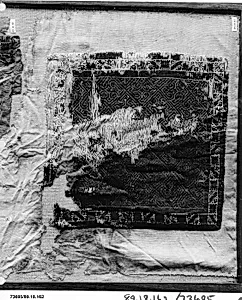
Textile Fragment
Unknown Artist
3rd–4th century
Medium
Wool, linen; plain weave, tapestry weave
Dimensions
Max. H. 11 7/8 in. (30.2 cm) Max. W. 11 7/8 in. (30.2 cm)
Classification
Textiles
Department
Islamic Art
Museum
Metropolitan Museum of Art, New York, NY
Credit
Purchase by subscription, 1889
Accession Number
89.18.162
Rights
Public Domain
Art Historical Context
This exquisite textile fragment, dating to the 3rd–4th century, offers a glimpse into the sophisticated weaving traditions of the early centuries in the Near East, now preserved in the Metropolitan Museum of Art's Department of Islamic Art. Crafted from wool and linen, it measures a modest 11⅞ x 11⅞ inches (30.2 x 30.2 cm) and exemplifies the durability of ancient fabrics that have survived millennia. Acquired through a subscription purchase in 1889, it reflects the museum's early commitment to collecting artifacts that bridge Late Antique and emerging Islamic cultures. The fragment combines plain weave—a foundational technique for sturdy, everyday textiles—with tapestry weave, where colored weft yarns create intricate patterns by interweaving over the warp. This labor-intensive method allowed artisans to produce vibrant, pictorial designs without painting or dyeing the entire cloth, making it ideal for garments, hangings, or ceremonial objects. Though the artist remains unknown, such pieces highlight the technical mastery of pre-Islamic weavers in regions like Egypt or Syria, whose innovations influenced later Islamic textile arts renowned for geometric motifs and calligraphy. Culturally, this fragment underscores textiles' vital role in daily life and trade across ancient Mediterranean and Near Eastern societies. Its presence in the Islamic Art collection connects it to a continuum of ornamental traditions that flourished under Islam, reminding us how fragile materials can weave rich historical narratives.