
Textile Fragment
Unknown Artist
5th century
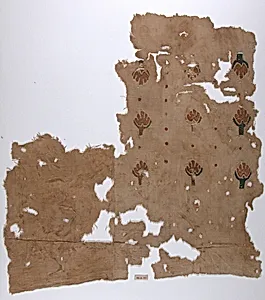
Medium
Wool, linen; plain weave, tapestry weave
Dimensions
Max. H. 17 15/16 in. (45.5 cm) Max. W. 11 5/8 in. (29.5 cm)
Classification
Textiles
Department
Islamic Art
Museum
Metropolitan Museum of Art, New York, NY
Credit
Purchase by subscription, 1889
Accession Number
89.18.177
Rights
Public Domain
Art Historical Context
This exquisite textile fragment, dating to the 5th, offers a rare glimpse into late antique weaving traditions preserved in the Metropolitan Museum of's Islamic Art Department.ed from wool and linendurable fibers ideal for everyday and ceremonial use in the ancient Near East or Mediterranean world—its modest dimensions (about 18 by 12 inches) suggest it once formed part of a larger garment, hanging, or furnishing. Acquired through a subscription purchase in 1889 it stands as a testament to early collecting efforts that enriched our understanding of pre-Islamic textile arts. The fragment showcases a masterful blend of plain weave and tapestry weave techniques. Plain weave provided a sturdy ground cloth, while tapestry weave allowed for intricate, discontinuous patterning, where colored weft threads were woven directly into the fabric to create motifs without floating yarns. This labor-intensive method, common in regions like Egypt's Coptic workshops or Sasanian Persia, highlights the technical sophistication of anonymous artisans whose work influenced later Islamic textile production. As a survivor from over 1,500 years ago, this piece underscores the cultural importance of textiles in daily life and trade across ancient civilizations. Though details of its exact design remain subtle in its fragmentary state, it invites us to marvel at the enduring legacy of these early craftspeople, bridging antiquity and the vibrant traditions of Islamic art.