
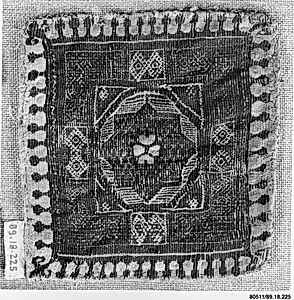
Textile Fragment
Unknown Artist
3rd–4th century
Medium
Wool, linen; plain weave, tapestry weave
Dimensions
H. 4 1/2 in. (11.4 cm) W. 4 1/4 in. (10.8 cm)
Classification
Textiles
Department
Islamic Art
Museum
Metropolitan Museum of Art, New York, NY
Credit
Purchase by subscription, 1889
Accession Number
89.18.225
Rights
Public Domain
Art Historical Context
This delicate textile fragment, dating to the 3rd–4th century, offers a glimpse into the vibrant world of Late Antique craftsmanship. Crafted from wool and linen using plain weave for the sturdy ground fabric and tapestry weave for decorative elements, it measures just 4½ by 4¼ inches—small enough to have adorned a garment, furnishing, or ritual object. Acquired by the Metropolitan Museum of Art through subscription purchase in 188, it resides in the Islamic Art department highlighting the continuity of textile traditions from pre-Islamic eras into the early Islamic world. The use of tapestry weave, where colored weft threads are woven over the warp to create patterns without floats, was a sophisticated technique prized for its durability and vivid colors. Wool provided warmth and richness, while linen added strength, making such fragments ideal for everyday or ceremonial use in regions like Egypt or the Near East, key hubs of ancient trade. Today, this unassuming piece underscores the cultural importance of textiles as one of the few surviving artifacts from antiquity. They reveal artistic ingenuity, dye technologies, and social customs, bridging pagan, Christian, and emerging Islamic influences in a shared Mediterranean heritage. A true treasure for textile enthusiasts!