
Textile Fragment
Unknown Artist
4th century
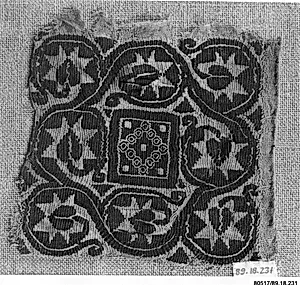
Medium
Wool, linen; plain weave, tapestry weave
Dimensions
H. 4 5/16 in. (11 cm) W. 4 5/16 in. (11 cm)
Classification
Textiles-Tapestries
Department
Islamic Art
Museum
Metropolitan Museum of Art, New York, NY
Credit
Purchase by subscription, 1889
Accession Number
89.18.231
Rights
Public Domain
Art Historical Context
This delicate *Textile Fragment* from the th century offers a glimpse into the sophisticated weaving traditions of the early Islamic world. Crafted from wool and linen using plain weave for the foundation and tapestry weave for colorful accents, this small square—measuring just 4 5/16 inches (11 cm) on each side—survives as a testament to ancient textile artistry. Acquired by the Metropolitan Museum of Art through a subscription purchase in 1889, it resides in the museum's Islamic Art department, the enduring allure of these fragile artifacts. The combination of techniques here is particularly noteworthy. Plain weave provided a sturdy tabby structure, while tapestry weave allowed weavers to create discontinuous patterns with vibrant, localized colors—a method prized for its efficiency and visual impact in pre-modern looms. Such textiles were essential for garments, furnishings, and trade goods, reflecting the technical prowess of artisans in regions like Egypt or the Near East during this era. Though its exact motifs are not detailed, this fragment embodies the cultural crossroads of the 4th century, bridging late antiquity and the dawn of Islamic influences. It invites us to marvel at how everyday materials wove stories of innovation, commerce, and daily life across centuries.