
Textile Fragment
Unknown Artist
5th–6th century
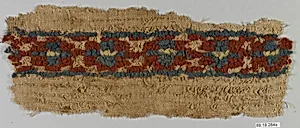
Medium
Wool, linen; plain weave, weft loop weave
Dimensions
Max. H. 13 3/16 in. (33.5 cm) Max. W. 21 7/8 in. (55.5 cm)
Classification
Textiles
Department
Islamic Art
Museum
Metropolitan Museum of Art, New York, NY
Credit
Purchase by subscription, 1889
Accession Number
89.18.284a
Rights
Public Domain
Art Historical Context
This exquisite *Textile Fragment* from the 5th–6th century offers a rare glimpse into the sophisticated textile traditions of Late Antiquity, housed in the Metropolitan Museum of Art's Islamic Art Department. Crafted from wool and linen, it exemplifies the era's mastery of weaving techniques, including plain weave for a sturdy base and weft loop weave, which created textured loops akin to early pile structures. Measuring about 13 by 22 inches at its maximum, this fragment likely originated from garments, furnishings, or trade goods in regions like Egypt, Syria, or the Near East, where such textiles were vital to daily life and commerce. The use of dual fibers—durable wool for warmth and fine linen for breathability—highlights practical innovation amid a burgeoning trade network connecting the Byzantine and Sasanian empires. Weft loop weave, a labor-intensive method, added visual and tactile appeal, possibly for decorative bands or borders on tunics or hangings. Acquired by the Met in 1889 through public subscription, it underscores early collector enthusiasm for these fragile survivors, which rarely endure due to their organic nature. As a testament to pre-Islamic craftsmanship influencing later Islamic arts, this piece reveals how everyday materials carried cultural prestige, blending utility with artistry in a vibrant, interconnected world.