
Textile Fragment
Unknown Artist
4th century
Medium
Wool, linen; plain weave, tapestry weave
Dimensions
Max. H. 3 15/16 in. (10 cm) Max. W. 3 13/16 in. (9.7 cm)
Classification
Textiles
Department
Islamic Art
Museum
Metropolitan Museum of Art, New York, NY
Credit
Purchase by subscription, 1889
Accession Number
89.18.306
Rights
Public Domain
Tags
Art Historical Context
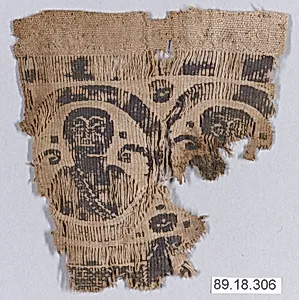
This delicate textile fragment, dating to the 4th, offers a rare glimpse into the artistry of late antiquity in the Near East. Housed in the Metropolitan Museum of Art's Islamic Department, it measures just under 4 inches square and features woven human figures—a tag that hints at its figurative narrative, common in early textiles from regions like Egypt during Coptic period. Acquired through subscription purchase in 1889 it survives as a testament to the enduring craftsmanship of anonymous weavers. Crafted from wool and linen using plain weave for the foundation and tapestry weave for detailed motifs, the fragment showcases sophisticated techniques. Plain weave provided a sturdy ground, while tapestry weave allowed colored wefts to create vibrant, pictorial designs without floats, ideal for small-scale scenes. These methods were labor-intensive, often produced in workshops for garments, hangings, or mummy wrappings. Though tiny, this piece holds cultural significance as an early example of figurative textile art in a collection spanning pre-Islamic to later Islamic traditions. It reflects a vibrant world of storytelling through cloth, bridging ancient weaving practices with the artistic legacies preserved in museum vaults today.