
Textile Fragment
Unknown Artist
3rd–4th century
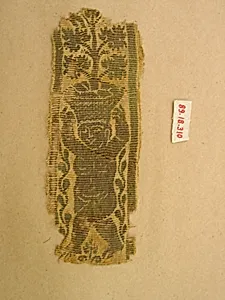
Medium
Wool, linen; tapestry weave
Dimensions
Max. H. 4 13/16 in. (12.2 cm) Max. W. 1 11/16 in. (4.3 cm)
Classification
Textiles
Department
Islamic Art
Museum
Metropolitan Museum of Art, New York, NY
Credit
Purchase by subscription, 1889
Accession Number
89.18.310
Rights
Public Domain
Tags
Art Historical Context
This delicate textile fragment, dating to the 3rd–4th century, offers a glimpse into the vibrant world of Late Antique weaving traditions. Crafted from wool and linen using the tapestry weave technique, it measures just 4 13/16 inches and 1 11/16 inches wide—small enough to have adorned a garment or furnishing. Housed in the Metropolitan Museum of Art's Art Department (purchased by subscription in 1889), it the exquisite craftsmanship of early textiles from regions like Egypt or the Near East, where such fragments survive from ancient burials or domestic use. The tapestry weave, a labor-intensive method where colored weft threads are woven back and forth to form discontinuous patterns, allowed for bold, pictorial designs without wasting yarn. Here, human figures—likely stylized and narrative—emerge as a key motif, reflecting a cultural embrace of figurative art before stricter aniconic traditions in later Islamic periods. These motifs often drew from daily life, mythology, or Nilotic scenes, bridging Greco-Roman, Coptic, and emerging Islamic influences. Though tiny, this fragment underscores the technical sophistication and artistic ambition of anonymous weavers, whose work preserved cultural stories through enduring fibers. A testament to everyday luxury in antiquity, it invites us to imagine the hands that wove it over 1,600 years ago.