
Textile Fragment
Unknown Artist
3rd–4th century
Medium
Wool, linen; tapestry weave
Dimensions
Max. H. 4 1/8 in. (10.5 cm) Max. W. 4 1/8 in. (10.5 cm)
Classification
Textiles
Department
Islamic Art
Museum
Metropolitan Museum of Art, New York, NY
Credit
Purchase by subscription, 1889
Accession Number
89.18.349
Rights
Public Domain
Tags
Art Historical Context
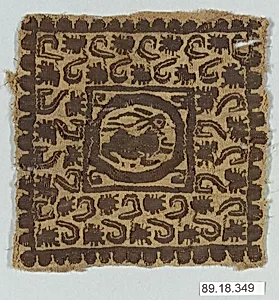
This delicate textile fragment, dating to the 3rd–4th century, offers a glimpse into the vibrant world of Late Antique weaving in the early Islamic cultural sphere. Crafted from wool and linen tapestry weave—a technique where discontinuous colored wefts create intricate patterns without floating threads—it measures just over 4 inches square. Housed in the Metropolitan Museum of Art's Art Department since its 1889 purchase, this small survivor showcases animal motifs, a common theme in textiles from Egypt or the Near East during this era. Tapestry weave was prized for its durability and ability to render detailed designs, much like a painting on fabric. Here, the animals likely symbolize fertility, protection, or daily life, reflecting the blend of pre-Islamic and emerging Islamic artistic traditions. Such fragments are rare treasures, as organic materials rarely endure; they highlight advanced dyeing and weaving skills passed down through generations. For visitors, this piece bridges antiquity and the Islamic golden age, reminding us how everyday crafts carried profound cultural weight. Next time you're in the galleries, imagine the hands that wove it under desert suns! (198 words)