
Textile Fragment
Unknown Artist
5th–6th century
Medium
Wool, linen; plain weave, tapestry weave
Dimensions
H. 17 15/16 in. (45.5 cm) W. 10 13/16 in. (27.5 cm)
Classification
Textiles
Department
Islamic Art
Museum
Metropolitan Museum of Art, New York, NY
Credit
Purchase by subscription, 1889
Accession Number
89.18.355
Rights
Public Domain
Art Historical Context
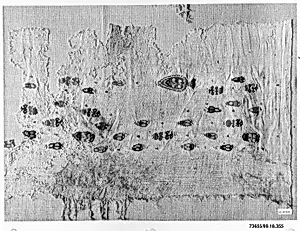
This delicate *Textile Fragment* from the th–6th century a glimpse into the sophisticated textile traditions of the early Islamic world. Crafted from wool and linen, it just 17 15/16 by 10 13/16 inches, likely a remnant of a larger garment, furnishing, or ceremonial cloth. Acquired by the Metropolitan Museum of Art in1889 through a subscriber purchase, it resides in the Islamic Art department, highlighting the enduring legacy of Near Eastern craftsmanship during late antiquity. The fragment showcases two key weaving techniques: plain weave for its sturdy, foundational structure, and tapestry weave, a labor-intensive method where colored weft yarns are woven directly into the fabric to create patterns without floats. This allowed artisans to produce vibrant motifs—though faded today—reflecting daily life, symbolism, or geometric designs common in the region. Such textiles were vital for trade, status, and cultural exchange across Byzantine, Sasanian, and emerging Islamic territories. As a survivor from over 1,500 years ago, this piece underscores the technical mastery of ancient weavers, whose innovations influenced Islamic art for centuries. Visitors can appreciate how everyday materials like wool and linen preserved stories of a vibrant era, bridging pre-Islamic and early caliphal periods.