
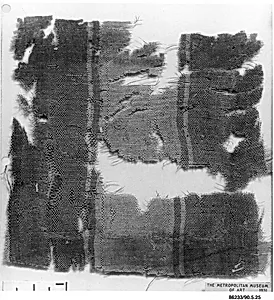
Textile Fragment
Unknown Artist
6th–7th century
Medium
Silk; plain weave
Dimensions
Max. H. 4 1/8 in. (10.5 cm) Max. W. 4 1/8 in. (10.5 cm)
Classification
Textiles
Department
Islamic Art
Museum
Metropolitan Museum of Art, New York, NY
Credit
Gift of George F. Baker, 1890
Accession Number
90.5.25
Rights
Public Domain
Art Historical Context
This delicate textile fragment, dating to the 6th–7th century, offers a glimpse into the opulent world of early Islamic artistry. Crafted from silk using a plain weave—a fundamental technique where warp and weft threads interlace at right angles—this small square (just over 4 inches on each side) exemplifies the luxurious materials prized in the period. Silk, imported via ancient trade routes like the Silk Road, symbolized and sophistication, often reserved for elite garments, furnishings, or ceremonial objects. Housed in the Museum of Art's Islamic Art Department, this fragment highlights the transitional era from late antiquity to the dawn of Islam, when textile production flourished in regions like Central Asia and the Near East. Though incomplete, its survival speaks to the enduring craftsmanship of anonymous weavers, whose work influenced broader Islamic decorative traditions. Plain weave allowed for durability and subtle sheen, making silk ideal for intricate patterns now lost to time. A generous gift from George F. Baker in 1890, this piece invites visitors to ponder the tactile splendor of early Islamic culture, where textiles wove together commerce, faith, and artistry.