
Textile Fragment
Unknown Artist
4th–5th century
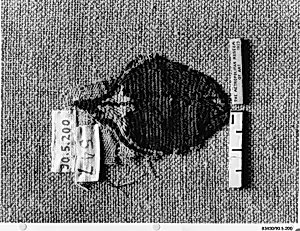
Medium
Wool, linen; plain weave, tapestry weave
Dimensions
H. 2 3/16 in. (5.5 cm) W. 1 3/4 in. (4.5 cm)
Classification
Textiles
Department
Islamic Art
Museum
Metropolitan Museum of Art, New York, NY
Credit
Gift of George F. Baker, 1890
Accession Number
90.5.200
Rights
Public Domain
Art Historical Context
This delicate textile fragment, dating to the 4th–5th century, offers a rare glimpse into the sophisticated weaving traditions of Late Antiquity. Housed in the Metropolitan Museum of Art's Department Islamic Art, it measures just 2 3/16 by 1 3/4 inches (5.5 by 4.5 cm), likely a remnant from a larger garment, furnishing, or ritual object. Crafted from wool and linen—staple fibers in ancient Mediterranean and Near Eastern cultures—it exemplifies the durability and versatility of these natural materials, which allowed textiles to survive burial contexts or arid environments. The fragment employs a combination of plain weave and tapestry weave techniques, highlighting early mastery of complex textile production. Plain weave provided a sturdy base, while tapestry weave allowed for intricate pattern insertion, creating vibrant motifs without supplementary wefts across the entire cloth. Such methods were labor-intensive, often produced in workshops across Egypt, Syria, or Persia, regions bridging Byzantine, Sasanian, and emerging Islamic worlds. As a gift from George F. Baker in 1890, this tiny artifact underscores the cultural importance of textiles in daily life and trade. Though small, it preserves evidence of artistic innovation and economic exchange, inviting us to marvel at the unseen hands that wove beauty into the fabric of history.