
Textile Fragment
Unknown Artist
5th–6th century
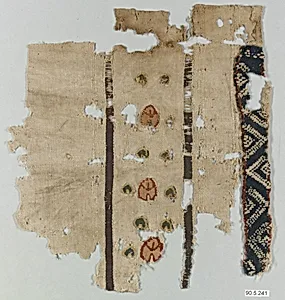
Medium
Wool, linen; plain weave, tapestry weave
Dimensions
Max. H. 9 15/16 in. (25.2 cm) Max. W. 9 1/16 in. (23 cm)
Classification
Textiles
Department
Islamic Art
Museum
Metropolitan Museum of Art, New York, NY
Credit
Gift of George F. Baker, 1890
Accession Number
90.5.241
Rights
Public Domain
Art Historical Context
This delicate Textile Fragment, dating to the 5th–6th, offers a rare glimpse into the sophisticated textile traditions of the early Islamic world—or its immediate precursors—in the Metropolitan Museum of Art's Islamic Art Department. Crafted wool and linen, it just under 10 inches square, a modest survivor from an era when such fabrics adorned clothing, furnishings, and ritual objects across the Near East and North Africa. Gifted to the Museum in 1890 by F. Baker, it exemplifies the fragility and allure of ancient textiles, which rarely endure due to their organic materials. The fragment showcases two key weaving techniques: plain weave, a foundational method for sturdy everyday cloth, and tapestry weave, which allowed artisans to create vibrant, pictorial patterns by interweaving colored wefts. This combination highlights the technical prowess of anonymous craftspeople, blending functionality with decorative flair. In the late antique period, such textiles were vital to trade, culture, and daily life, influencing later Islamic opulence in patterns and dyes. Today, this unassuming piece invites us to marvel at the unseen hands behind early woven art, bridging antiquity to the Islamic golden age and reminding visitors of textiles' role as a universal language of beauty and ingenuity.