
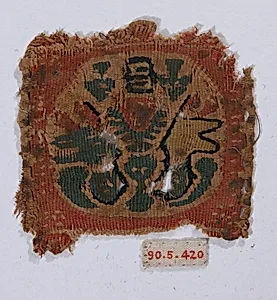
Textile Fragment
Unknown Artist
5th century
Medium
Wool, linen; plain weave, tapestry weave
Dimensions
Max. H. 2 3/4 in. (7 cm) Max. W. 2 3/4 in. (7 cm)
Classification
Textiles
Department
Islamic Art
Museum
Metropolitan Museum of Art, New York, NY
Credit
Gift of George F. Baker, 1890
Accession Number
90.5.420
Rights
Public Domain
Art Historical Context
This delicate Textile Fragment, dating to the 5th century, offers a glimpse into the sophisticated textile traditions of the early Islamic world. Crafted from wool and linen using a combination of plain weave and weave, it measures just 2¾ inches (7 cm) square—likely a surviving piece from a larger garment, furnishing, or ceremonial object. Housed in the Metropolitan Museum Art's Islamic Art Department it was generously gifted by George F. Baker in 1890, preserving this ancient artistry for modern eyes. The dual weaving techniques highlight the era's masterful craftsmanship: plain weave provided a sturdy base, while tapestry weave allowed for intricate patterns, often depicting motifs like animals, geometrics, or floral designs common in late antique textiles from the Near East. These methods were labor-intensive, requiring skilled weavers to interlace colored yarns directly into the fabric, creating vibrant, durable designs without additional sewing. As a rare survivor from over 1,500 years ago, this fragment underscores the cultural importance of textiles in early Islamic societies, where they served practical and symbolic roles in daily life, trade, and status. Though small, it connects us to the innovative spirit of artisans whose techniques influenced centuries of Islamic art.