
Textile Fragment
Unknown Artist
4th–5th century
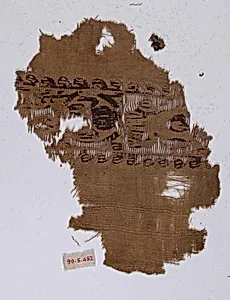
Medium
Wool, linen; plain weave, tapestry weave
Dimensions
Max. H. 6 5/16 in. (16 cm) Max. W. 5 5/16 in. (13.5 cm)
Classification
Textiles
Department
Islamic Art
Museum
Metropolitan Museum of Art, New York, NY
Credit
Gift of George F. Baker, 1890
Accession Number
90.5.452
Rights
Public Domain
Art Historical Context
This delicate textile fragment, dating to the 4th–5th century, offers a glimpse into the sophisticated weaving traditions of the Late Antique world. Crafted from wool and linen using plain weave for the ground and tapestry weave for decorative elements, it measures just 6 5/16 by 5 5/16 inches (16 by 13.5 cm). Housed in the Metropolitan Museum of Art's Department of Islamic Art, it was generously gifted by George F. Baker in1890. Such small survivors from antiquity highlight how everyday fabrics—likely from garments, furnishings, or ritual objects—endured through the sands of time. The dual weaving techniques showcase remarkable technical skill: plain weave provided a sturdy, flexible base, while tapestry weave allowed artisans to create vibrant, pictorial motifs by interweaving colored wefts. Wool offered durability and warmth, linen breathability and fineness, making these materials ideal for the diverse climates of the ancient Near East and Egypt. Textiles like this were labor-intensive, often produced in workshops, and reveal the cultural exchange along trade routes. As a rare artifact in the Islamic Art collection, this fragment bridges pre-Islamic and early Islamic eras, underscoring the continuity of textile arts in regions that shaped Islamic material culture. Visitors are invited to marvel at its preservation, a testament to ancient craftsmanship that still captivates today.