
Textile Fragment
Unknown Artist
5th century
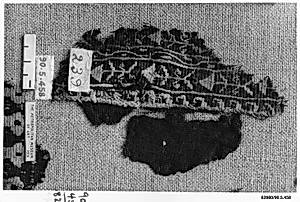
Medium
Wool, linen; plain weave, tapestry weave
Dimensions
Max. H. 4 5/16 in. (11 cm) Max. W. 2 9/16 in. (6.5 cm)
Classification
Textiles
Department
Islamic Art
Museum
Metropolitan Museum of Art, New York, NY
Credit
Gift of George F. Baker, 1890
Accession Number
90.5.458
Rights
Public Domain
Art Historical Context
This delicate textile fragment, dating to the 5th, offers a glimpse into the sophisticated weaving traditions of the early Islamic world. Crafted from wool and linen plain weave for the foundation and tapestry weave for decorative elements, it measures just 4 5/16 inches by 2 9/16 inches wide—small enough to fit in the palm of your hand, yet rich with historical resonance. Housed in the Metropolitan Museum Art's Islamic Art Department it was generously gifted by George F. Baker in 1890. The combination of plain weave, a sturdy and versatile technique for everyday textiles, with tapestry weave highlights the era's technical prowess. Tapestry weave allowed weavers to create vibrant, pictorial designs by interweaving colored threads, often depicting motifs like animals, geometrics, or floral patterns that symbolized prosperity and protection. Though the artist remains unknown, such fragments were likely parts of garments, furnishings, or trade goods exchanged along ancient Silk Road routes. In the context of 5th-century Islamic cultural precursors—bridging Sasanian, Byzantine, and early Coptic influences—these textiles underscore the region's role as a crossroads of artistry and commerce. They remind us how everyday fabrics preserved stories of daily life, spirituality, and innovation, surviving centuries to enchant modern visitors.