
Textile Fragment
Unknown Artist
4th century
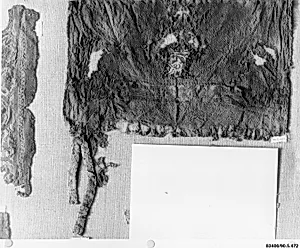
Medium
Wool, linen; plain weave, tapestry weave
Dimensions
Max. H. 12 in. (30.5 cm) Max. W. 7 3/16 in. (18.3 cm)
Classification
Textiles
Department
Islamic Art
Museum
Metropolitan Museum of Art, New York, NY
Credit
Gift of George F. Baker, 1890
Accession Number
90.5.472
Rights
Public Domain
Art Historical Context
This delicate textile fragment from the 4th century offers a glimpse into the sophisticated weaving traditions of the Late Antique world, preserved in the Metropolitan Museum of Art's Islamic Art. Crafted from wool and linen using a combination of plain weave for the ground fabric and tapestry weave for colorful motifs, it exemplifies early techniques that allowed artisans to create intricate designs by interweaving dyed threads. At just 12 inches high and 7 3/16 inches wide, surviving piece hints at larger garments, furnishings, or ceremonial textiles that once adorned daily life. In the 4th century, such textiles were produced in regions bridging the classical and emerging Islamic eras, likely in Egypt or the Near East, where wool and linen were abundant and valued for their durability and versatility. Tapestry weave, a labor-intensive method predating later Islamic figural styles, enabled vivid patterns that conveyed cultural motifs, possibly geometric or floral, reflecting trade, religion, and artistry across Mediterranean cultures. These fragments are rare survivors, often unearthed from burials, underscoring their role in personal and communal identity. Generously gifted by George F. Baker in 1890, this artifact connects us to anonymous makers whose skill influenced centuries of textile innovation, inviting visitors to appreciate the tactile artistry of antiquity.