
Textile Fragment
Unknown Artist
4th century
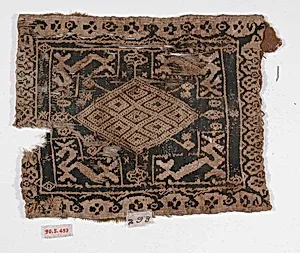
Medium
Wool, linen; tapestry weave
Dimensions
Max. H. 6 7/8 in. (17.5 cm) Max. W. 5 1/2 in. (14 cm)
Classification
Textiles
Department
Islamic Art
Museum
Metropolitan Museum of Art, New York, NY
Credit
Gift of George F. Baker, 1890
Accession Number
90.5.493
Rights
Public Domain
Art Historical Context
This delicate textile fragment, dating to the 4th century, offers a glimpse into the sophisticated weaving traditions of the late antique world. Crafted from wool and linen in a weave—a labor-intensive technique where colored weft threads are woven discontinuously to form patterns directly in the fabric—it measures just 6 7/8 by 5 1/2 inches. Such small survivals highlight the fragility of ancient textiles, which rarely endure due to their organic materials. Housed in the Metropolitan Museum Art's Department of Islamic Art and gifted by George F. Baker in 1890, this piece reflects the artistic excellence of early textile production in regions like Egypt or the Near East, where weaving was both a practical craft and an art form. Tapestry weaves from this era were prized for their durability and vivid designs, often used for garments, furnishings, or ceremonial objects, bridging pagan, Christian, and emerging Islamic influences. Though its exact motifs are not detailed, the fragment's preservation underscores the cultural value of textiles as everyday luxury items, revealing advanced technical skill and aesthetic sensibility in a time of cultural transition. A true treasure for visitors fascinated by the threads of history!