
Panel
Roman period (30 BCE– 641 CE), 3rd/5th century
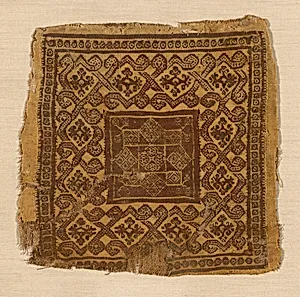
Medium
Wool, tapestry weave
Dimensions
20.2 × 20.5 cm (7 7/8 × 8 in.)
Classification
textile
Department
Textiles
Museum
Art Institute of Chicago
Accession Number
93024
Rights
Public Domain
Art Historical Context
This exquisite Coptic tapestry panel, woven from wool during Egypt's Roman period (3rd or 5th CE), offers a window into the vibrant world of Christian textile art. Measuring just 20.2 × 20.5 cm, it likely served as a decorative band from garment, curtain, or liturgical hanging, reflecting the daily life and spiritual beliefs of Coptic communities in Late Antique Egypt. As Christianity took root amid Roman rule, Coptic artisans blended pharaonic traditions, Greco-Roman motifs, and emerging Christian iconography, creating textiles that were both functional and profoundly symbolic. The panel's tapestry weave technique—where colored weft threads are woven directly into the warp to form patterns—is a hallmark of Coptic mastery. This labor-intensive method allowed for rich, durable designs in brilliant hues, often featuring animals, plants, or human figures against geometric borders. Wool's availability made it ideal for clothing in Egypt's climate, preserving these fragments for centuries despite heavy use. Housed in the Art Institute of Chicago's Textiles Department, this panel highlights the cultural crossroads of Egypt, where pagan, Jewish, and Christian influences converged. Such artifacts reveal how everyday objects became canvases for artistic expression, bridging ancient traditions with the dawn of Byzantine art. A true treasure for textile enthusiasts!
About the Artist
Coptic
Coptic, the collective attribution for anonymous masters of early Christian Egypt, embodies the vibrant fusion of pharaonic, Hellenistic, and Greco-Roman traditions that defined art from the 4th century onward. Emerging in the context of Coptic Christianity's rise after the 1st century AD, these artists operated amid economic constraints that favored functional craftsmanship over elite patronage, ...