
Textile Fragment
Unknown Artist
6th–7th century
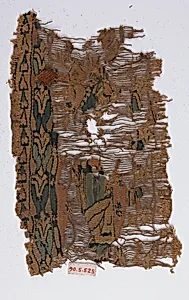
Medium
Wool, linen; tapestry weave
Dimensions
Max. H. 6 5/16 in. (16 cm) Max. W. 4 1/2 in. (11.5 cm)
Classification
Textiles
Department
Islamic Art
Museum
Metropolitan Museum of Art, New York, NY
Credit
Gift of George F. Baker, 1890
Accession Number
90.5.525
Rights
Public Domain
Art Historical Context
This delicate textile fragment, dating to the 6th–7th century, offers a glimpse into the sophisticated world of early Islamic textile production. Crafted from wool and linen using tapestry weave—a labor-intensive technique where colored weft threads are woven discontinuously to form motifs—this small piece (just 6 5/16 by 4 1/2 inches) likely originated from a larger garment, curtain, or furnishing. Its presence in the Metropolitan Museum of Art's Islamic department highlights the vibrant textile traditions flourishing in the Near East during this transitional era, bridging Late Antique and early Islamic cultures. Tapestry weave was prized for its durability and ability to create bold, pictorial designs without relying on dyes alone, making it ideal for both practical and decorative uses. Wool provided warmth and richness, while linen added strength, reflecting the skilled craftsmanship of weavers who drew from Byzantine, Sasanian, and emerging Islamic influences. Such fragments are rare survivors, preserved perhaps by Egypt's arid sands, where many Coptic and early Islamic textiles were discovered. Generously gifted to the Met in 1890 by George F. Baker, this artifact underscores textiles' role as everyday art—symbols of status, trade, and cultural exchange in a dynamic period of history. Visitors are invited to imagine it adorning a bustling marketplace or noble household, a testament to artistry that endured through centuries.