
Textile Fragment
Unknown Artist
5th century
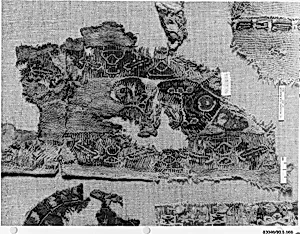
Medium
Wool, linen; plain weave, tapestry weave
Dimensions
Max. H. 10 5/8 in. (27 cm) Max. W. 5 5/8 in. (14.3 cm)
Classification
Textiles
Department
Islamic Art
Museum
Metropolitan Museum of Art, New York, NY
Credit
Gift of George F. Baker, 1890
Accession Number
90.5.565
Rights
Public Domain
Art Historical Context
This delicate textile fragment, dating to the 5th century, offers a glimpse into the sophisticated weaving traditions of the early medieval Near East. Crafted from wool and linen using plain weave for the foundation and tapestry weave for decorative elements, it measures just 10⅝ by 5⅝ inches—likely a surviving piece from a larger garment, curtain, or furnishing. Housed in the Metropolitan Museum of Art's Islamic Art Department, it entered the collection as a gift from George. Baker in 1890, highlighting the era's enduring appeal to collectors. The dual-weave technique is particularly noteworthy: plain weave provided a sturdy, balanced structure, while tapestry weave allowed weavers to create vibrant, pictorial patterns by fully covering the warp with colored wefts. This method, common in Late Antique and pre-Islamic cultures across Egypt, Syria, and Persia, foreshadowed the intricate textiles of early Islamic art, where such skills adorned elite households and mosques. Though small, this fragment underscores textiles' cultural primacy in ancient societies, serving practical and symbolic roles. Its preservation reveals masterful craftsmanship from an anonymous artisan, bridging classical antiquity and the dawn of Islamic civilization—a testament to the continuity of artistic innovation in the region.