
Textile Fragment
Unknown Artist
7th–8th century
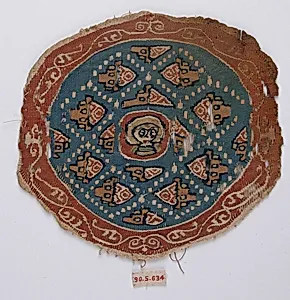
Medium
Wool, linen; tapestry weave
Dimensions
Max. H. 6 3/16 in. (15.7 cm) Max. W. 5 13/16 in. (14.7 cm)
Classification
Textiles
Department
Islamic Art
Museum
Metropolitan Museum of Art, New York, NY
Credit
Gift of George F. Baker, 1890
Accession Number
90.5.634
Rights
Public Domain
Art Historical Context
This delicate Textile Fragment, dating to the 7th–8th century, offers a glimpse into the vibrant of early Islamic artistry. Woven in tapestry technique from wool and linen, it measures just 6 3/16 by 5 13/16 inches, suggesting it was once part of a larger garment, furnishing, or ceremonial object. Tapestry weave, where colored weft threads are inserted in discrete sections to create patterns, allowed artisans to produce intricate designs efficiently, blending practicality with beauty—a hallmark of Islamic textile production. Crafted during the formative Umayyad era, when Islam rapidly expanded across the Middle East, North Africa, and beyond, such fragments highlight the cultural synthesis of Byzantine, Sasanian, and local traditions. Textiles were prized commodities in trade routes, adorning mosques, palaces, and elite wardrobes, symbolizing wealth and piety through their rich colors and motifs. Though the exact design is not detailed here, surviving examples often feature geometric patterns or stylized flora, reflecting aniconic aesthetics that emphasized abstraction and infinity. Preserved as a gift to the Metropolitan Museum of Art in 1890 by George F. Baker, this fragment endures as a testament to ancient craftsmanship. It invites us to ponder the skilled, unnamed hands that wove it, bridging over a millennium of history in the Islamic Art collection.