
Textile Fragment
Unknown Artist
5th–6th century
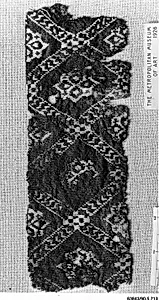
Medium
Wool, linen; plain weave, brocaded (?)
Dimensions
Max. H. 8 1/4 in. (21 cm) Max. W. 2 13/16 in. (7.1 cm)
Classification
Textiles
Department
Islamic Art
Museum
Metropolitan Museum of Art, New York, NY
Credit
Gift of George F. Baker, 1890
Accession Number
90.5.713
Rights
Public Domain
Art Historical Context
This delicate textile fragment, dating to the 5th–6th century, offers a rare glimpse into the sophisticated weaving traditions of Late Antiquity in the Near East or Egypt, regions central to early Islamic cultural heritage. Crafted from wool and linen in a plain weave with possible brocading—a technique where supplementary wefts create raised decorative patterns—it measures just 8¼ inches high and 2⅞ inches wide, likely a surviving piece from a larger garment, curtain, or furnishing. The use of wool for durability and linen for fine texture reflects practical choices suited to the region's climate and trade networks, where such textiles facilitated commerce along Silk Road routes. Brocading, if present, highlights advanced technical skill, adding texture and color without complex looms, a hallmark of pre-Islamic craftsmanship that influenced later Islamic textile arts. Preserved through the generous 1890 gift of George F. Baker, this fragment now resides in The Metropolitan Museum of Art's Islamic Art Department. Such small survivors illuminate everyday artistry, weaving history into the fabric of cultural exchange during a pivotal era.