
Textile Fragment
Unknown Artist
5th–6th century
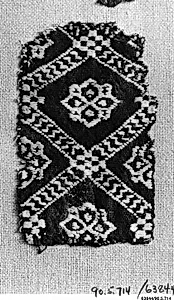
Medium
Wool, linen; plain weave, brocaded (?)
Dimensions
Max. H. 4 9/16 in. (11.6 cm) Max. W. 2 3/4 in. (7 cm)
Classification
Textiles
Department
Islamic Art
Museum
Metropolitan Museum of Art, New York, NY
Credit
Gift of George F. Baker, 1890
Accession Number
90.5.714
Rights
Public Domain
Art Historical Context
This delicate textile fragment, dating to the 5th–6th century, a glimpse into the sophisticated weaving traditions of the early Islamic world. Crafted from wool and linen in a plain weave with possible brocading—a technique where supplementary weft yarns create raised patterns—it exemplifies the technical prowess of ancient artisans. Though small, measuring just 4 9/16 x 2 3/4 inches, such fragments were likely parts of larger garments, furnishings, or ceremonial textiles traded across regions like Egypt, Syria, or Persia. In the Department of Islamic Art at The Metropolitan Museum of Art, this piece highlights the continuity of pre-Islamic craftsmanship into the formative years of Islam. Plain weave provided a sturdy base, while brocading added decorative flair, often featuring motifs symbolizing status or protection. These textiles were prized commodities on Silk Road routes, blending Byzantine, Sasanian, and local influences. A generous gift from George F. Baker in 1890, this fragment invites visitors to ponder the hands that wove it centuries ago—evidence of enduring cultural artistry in everyday materials.