
Textile Fragment
Unknown Artist
5th–6th century
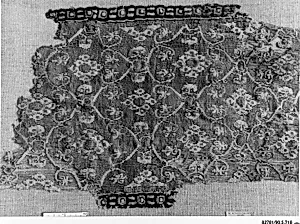
Medium
Wool, linen; tapestry weave
Dimensions
Max. H. 16 5/8 in. (42.3 cm) Max. W. 9 7/16 in. (24 cm)
Classification
Textiles
Department
Islamic Art
Museum
Metropolitan Museum of Art, New York, NY
Credit
Gift of George F. Baker, 1890
Accession Number
90.5.718
Rights
Public Domain
Art Historical Context
This exquisite *Textile Fragment* from the 5th–6th century offers a rare glimpse into the sophisticated textile arts of the late ancient world. Crafted in wool and linen using weave—a labor-intensive technique where colored wefts are woven perpendicular to the warp to create intricate patterns—this fragment exemplifies the technical mastery of early weavers in the Eastern Mediterranean or Near East. Measuring just 16⅝ by 9⅞ inches, it survives as a testament to everyday luxury, likely adorning garments, furnishings, or ceremonial objects. Classified within the Metropolitan Museum of Art's Islamic Art department, the piece bridges Late Antiquity and the dawn of Islamic culture. Tapestry weaves like this were prized for their durability and vivid color retention, techniques that persisted and evolved in later Islamic textiles. Donated in 1890 by George F. Baker, it highlights how such fragile artifacts, preserved in arid conditions like ancient Egyptian tombs, reveal the vibrant trade networks and artistic exchanges of the era. Though the artist remains unknown, the fragment's preservation underscores the cultural significance of textiles as portable art forms, carrying motifs and skills across civilizations and influencing centuries of design. Visitors can marvel at its tactile beauty, a window into lives woven with color and skill.