
Textile Fragment
Unknown Artist
3rd–4th century
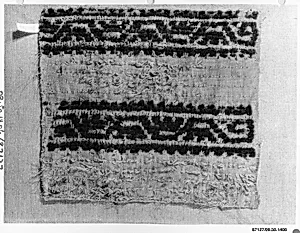
Medium
Linen, wool; tapestry weave, looped embroidery
Dimensions
H. 8 1/2 in. (21.6 cm) W. 9 1/2 in. (24.1 cm)
Classification
Textiles
Department
Islamic Art
Museum
Metropolitan Museum of Art, New York, NY
Credit
Rogers Fund, 1909
Accession Number
09.50.1406
Rights
Public Domain
Art Historical Context
This delicate *Textile Fragment* from the rd–4th century a glimpse into the sophisticated textile arts of the ancient Near East or Egypt, now housed in the Metropolitan Museum of Art Islamic Art department. Measuring just 8½ by 9½ inches, it was crafted from linen and wool using tapestry weave—a technique where colorful discontinuous wefts create intricate patterns without floating threads—and looped embroidery, which forms textured, looped motifs for added depth and decoration. Acquired through the Rogers Fund in 1909, it exemplifies the durability of these materials, surviving centuries as a precious remnant. In the Late Antique period bridging Roman, Byzantine, and early Islamic worlds, such textiles adorned clothing, furnishings, or ceremonial objects, reflecting a cultural crossroads of trade and craftsmanship. The combination of tapestry weave and embroidery highlights technical innovation, allowing vibrant, pictorial designs that influenced later Islamic textile traditions. Though the artist remains unknown, this fragment underscores the anonymous mastery of weavers whose work preserved motifs of daily life, nature, and symbolism across eras. Visitors will appreciate how this small piece reveals the tactile artistry of antiquity—feel the loops in your imagination and marvel at its journey to our virtual gallery!