
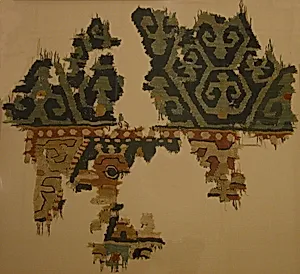
Textile Fragment
Unknown Artist
9th–10th century
Medium
Wool; tapestry weave
Dimensions
Textile: L. 13 in. (33 cm) W. 10 in. (25.4 cm) Mount: L. 22 1/2 in. (57.2 cm) W. 23 7/8 in. (60.6 cm) D. 1 in. (2.5 cm)
Classification
Textiles-Woven
Department
Islamic Art
Museum
Metropolitan Museum of Art, New York, NY
Credit
Rogers Fund, 1927
Accession Number
27.170.74
Rights
Public Domain
Art Historical Context
This exquisite *Textile Fragment*, dating to the 9th–10th century, offers a rare glimpse into the sophisticated world of Islamic textile production during the Abbasid era. Crafted from wool using tapestry weave—a technique where colored weft yarns are woven discontinuously to create intricate patterns—this small piece (13 x 10 inches) survives as a testament to the era's mastery of fiber arts. Housed in the Metropolitan Museum of Art's of Islamic Art, it acquired through the Rogers Fund in 7, underscoring its value as a cultural treasure. Tapestry weave, prized in the Islamic world for its durability and vivid color retention, allowed artisans to produce richly decorative textiles for clothing, furnishings, and ceremonial use. These fabrics were central to daily life and trade across the vast caliphate, from Baghdad to Spain, symbolizing wealth and piety. Though fragmented, this wool example highlights the technical precision required—each motif laboriously interlocked by hand—reflecting a golden age when Islamic weavers influenced global design traditions. Visitors, imagine draping your home with such vibrant heirlooms! This fragment invites us to appreciate the artistry of anonymous creators whose innovations in weaving continue to inspire modern textiles.