
Textile Fragment
Unknown Artist
15th–16th century
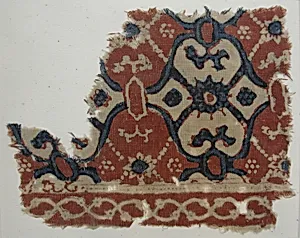
Medium
Cotton, plain weave; block-printed, mordant and resist dyed
Dimensions
L. 8 in. (20.3. cm) W. 6 1/4 in. (15.9 cm)
Classification
Textiles-Painted and/or Printed
Department
Islamic Art
Museum
Metropolitan Museum of Art, New York, NY
Credit
Purchase, V. Everit Macy Gift, 1930
Accession Number
30.112.36
Rights
Public Domain
Art Historical Context
This delicate textile fragment, dating to the 15th–16th century, hails from the Islamic world and showcases the exquisite craftsmanship of block-printed cotton. Woven in a plain weave on cotton—a lightweight, breathable fabric ideal for garments and furnishings in warm climates—this small piece (just 8 by 6¼ inches) survives as a testament to enduring artistic traditions. Acquired by The Metropolitan Museum of Art in1930 through the V. Everit Macy, it resides in the Islamic Art department highlighting textiles as vital cultural artifacts. The fragment's creation involved sophisticated block-printing techniques, where carved wooden blocks were dipped in dyes and stamped onto the fabric. Mordant dyeing fixed colors like vibrant reds by using chemical agents that bind the dye to the fibers, while resist dyeing protected areas from color absorption, creating intricate patterns through careful layering. These methods demanded precision and skill, reflecting advanced textile production in regions where such fabrics were prized for trade and daily life. In the Islamic artistic tradition, textiles like this were more than functional; they embodied cultural exchange along trade routes, blending utility with beauty. Though incomplete, this fragment invites us to appreciate the anonymous artisans whose innovations influenced global design for centuries.