
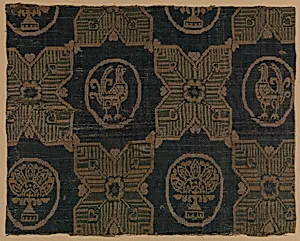
Textile Fragment
Unknown Artist
8th–9th century
Medium
Silk; samite
Dimensions
Textile: H. 8 1/4 in. (21 cm) W. 10 1/4 in. (26 cm) Mount: H. 11 7/8 (30.2 cm) W. 13 7/8 in. (35.2 cm) D. 1 1/4 in. (3.2 cm)
Classification
Textiles-Woven
Department
Islamic Art
Museum
Metropolitan Museum of Art, New York, NY
Credit
Fletcher Fund, 1946
Accession Number
46.156.6
Rights
Public Domain
Tags
Art Historical Context
This exquisite silk samite textile fragment dating to the 8th–9th century, hails from the vibrant world of early Islamic art. Woven during the Abbasid era or shortly after, it exemplifies the opulence of Central Asian or Near Eastern textile production, where silk was a prized luxury good traded along the Silk Road. Measuring just 8¼ by 10¼ inches, this small survivor hints at grander garments or furnishings, now preserved in the Metropolitan Museum of Art's Islamic Art Department thanks to the Fletcher Fund 1946. Samite, a weft-faced satin weave, creates a rich, shimmering surface ideal for intricate patterns—here likely featuring birds, as suggested by its tags. These avian motifs were symbolic in Islamic culture, evoking grace, freedom, and paradise gardens from Qur'anic imagery. The technique demanded skilled looms and dyers, blending Byzantine, Sasanian, and local influences into a distinctly Islamic aesthetic that dazzled courts and merchants alike. Though fragmented, this piece illuminates a golden age of textile innovation, where silk not only clothed elites but also served as diplomatic gifts and status symbols. Visitors, imagine draping your robes in such luster— a testament to artistry that bridged empires.