
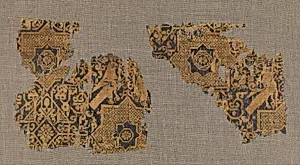
Textile with a Pattern of Stars and Birds, Originally from a Cap
Unknown Artist
11th–12th century
Medium
Silk; samite
Dimensions
Textile: H. 5 in. (12.7 cm) W. 5 1/4 in. (13.3 cm) Mount: H. 7 3/4 in. (19.7 cm) W. 12 3/4 in. (32.4 cm) D. 7/8 in. (2.2 cm)
Classification
Textiles-Woven
Department
Islamic Art
Museum
Metropolitan Museum of Art, New York, NY
Credit
Fletcher Fund, 1946
Accession Number
46.156.11a
Rights
Public Domain
Art Historical Context
This delicate silk samite textile, dating to the 11th–12th, once adorned a cap in the Islamic world, showcasing the era's masterful weaving traditions. Measuring just 5 by 5¼ inches, its intricate pattern of stars and birds a celestial harmony, where radiant motifs float against a shimmering ground. Such designs were common in Islamic art,izing the heavens, paradise, and the beauty of creation, often drawing from poetic and spiritual inspirations. Crafted in samite—a luxurious weft-faced satin weave—the fabric gleams with a characteristic luster from its silk threads, prized for both durability and opulence. This technique, perfected in workshops across Persia, Central Asia, and the Byzantine sphere, highlights the Silk Road's vibrant trade networks, where silk became a medium for cultural exchange and elite status symbols. Worn on the head, this fragment blended functionality with artistry, transforming everyday attire into a canvas of wonder. Today, preserved in the Metropolitan Museum of Art's Islamic Art department through the Fletcher Fund of 1946, it offers a glimpse into medieval Islamic textile innovation, reminding us how portable luxuries carried stories across continents.