
Textile Fragment
Unknown Artist
8th–9th century
Medium
Wool
Dimensions
H. 4 1/2 in. (11.4 cm) W. 9 1/4 in. (23.5 cm)
Classification
Textiles-Woven
Department
Islamic Art
Museum
Metropolitan Museum of Art, New York, NY
Credit
Rogers Fund, 1953
Accession Number
53.124.3
Rights
Public Domain
Art Historical Context
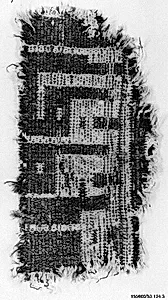
This delicate wool textile fragment, dating to the 8th–9th century, offers a rare glimpse into the early Islamic world during the Abbasid era. Housed in the Metropolitan Museum of Art's Islamic department, it measures just 4½ by 9¼ inches, likely a surviving piece from a larger garment, furnishing, or ceremonial object. Woven from wool—a durable and versatile fiber—this fragment exemplifies the sophisticated textile production that flourished across the Islamic realms, from Mesopotamia to North Africa. In the context of Islamic art, woven textiles held immense cultural and economic value, serving as symbols of wealth, piety, and craftsmanship. Wool weaving techniques allowed for intricate patterns and bold colors, often produced on horizontal looms by skilled artisans in urban centers like Baghdad or Fustat (old Cairo). Such fragments are invaluable today, as organic materials rarely survive, preserving evidence of trade networks that connected the Mediterranean to Central Asia. Acquired through the Rogers Fund in 1953, this piece invites us to imagine the vibrant markets and nomadic traditions of the time, where textiles bridged art, utility, and spirituality. A testament to enduring artistry, it reminds visitors of the Islamic golden age's innovative legacy.