
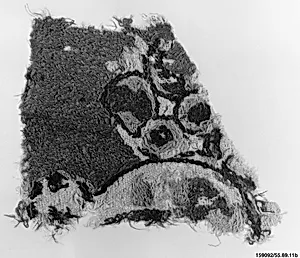
Textile Fragment
Unknown Artist
8th–9th century
Medium
Wool; embroidered
Dimensions
H. 4 1/2 in. (11.4 cm) W. 3 1/2 in. (8.9 cm)
Classification
Textiles-Embroidered
Department
Islamic Art
Museum
Metropolitan Museum of Art, New York, NY
Credit
Rogers Fund, 1955
Accession Number
55.69.11b
Rights
Public Domain
Art Historical Context
This delicate *Textile Fragment*, dating to the 8th–9th century, offers a glimpse into the refined world of early Islamic artistry. Crafted from wool and meticulously embroidered, it measures just 4½ by 3½ inches (11.4 × 8.9 cm), likely a surviving piece from a larger garment, furnishing, or ceremonial object. Housed in the Metropolitan Museum Art's Islamic Art Department acquired through the Rogers Fund in 195, it exemplifies the portable luxury of textiles in the expansive Islamic world, from the Umayyad to early Abbasid eras. Embroidery on wool was a prized technique during this period, allowing artisans to create intricate patterns with durable threads that withstood daily use and trade along Silk Road routes. These fragments highlight the technical prowess of anonymous makers, who blended functionality with aesthetic elegance—hallmarks of Islamic decorative arts. Though small, such pieces reveal how textiles served as canvases for cultural expression, adorning tents, mosques, and elite wardrobes. Today, this fragment invites us to marvel at the resilience of ancient craftsmanship. Preserved against the odds, it connects us to a vibrant era when wool embroidery bridged artisans across regions, enriching the global tapestry of art history.