
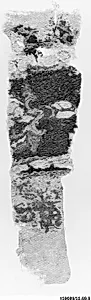
Textile Fragment
Unknown Artist
8th–9th century
Medium
Wool; embroidered
Dimensions
H. 2 1/2 in. (6.4 cm) W. 9 1/2 in. (24.1 cm)
Classification
Textiles-Embroidered
Department
Islamic Art
Museum
Metropolitan Museum of Art, New York, NY
Credit
Rogers Fund, 1955
Accession Number
55.69.9
Rights
Public Domain
Art Historical Context
This delicate *Textile Fragment*, crafted from embroidered wool in the 8th–9th century, a tantalizing glimpse into early Islamic artistry. Measuring just 2½ by 9½ inches, it survives as a precious remnant, likely from a larger garment, furnishing, or ceremonial object. Housed in the Metropolitan Museum of Art's Islamic Department—acquired through the Rogers Fund in 5—it exemplifies the exquisite craftsmanship of the Abbasid era, when textiles flourished as symbols of wealth, piety, and cultural exchange across the Islamic world. Embroidered with wool threads, the fragment highlights a labor-intensive technique where motifs were meticulously stitched onto a base fabric, often featuring geometric patterns, floral designs, or script that conveyed spiritual or protective meanings. Wool was a practical yet luxurious medium in arid regions, prized for its durability and vibrant dyes derived from plants and insects. Such pieces were traded along Silk Road routes, blending influences from Persia, Central Asia, and beyond. Though its full design is incomplete, this artifact underscores the centrality of textiles in Islamic daily life and art, where embroidery served both aesthetic and narrative purposes. Visitors, imagine the skilled hands that created it amid bustling medieval workshops— a testament to enduring creativity!