
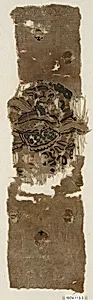
Textile Fragment
Unknown Artist
9th century
Medium
Linen and wool; tapestry-woven
Dimensions
H. 16 1/4 in. (41.3 cm) W. 4 3/4 in. (12.1 cm) Mount: H. 22 in. (55.9 cm) W. 16 in. (40.6 cm)
Classification
Textiles-Woven
Department
Islamic Art
Museum
Metropolitan Museum of Art, New York, NY
Credit
Rogers Fund, 1974
Accession Number
1974.113.3
Rights
Public Domain
Art Historical Context
Step into the rich tapestry of 9th-century Islamic art with this delicate *Textile Fragment*, a survivor from the early Abbasid era. Crafted from linen and wool using the tapestry-weave technique, this narrow strip—measuring just 16¼ by 4¾ inches—hints at the luxurious textiles that adorned garments, furnishings, and trade goods across the Islamic world. Likely produced in Egypt or the eastern Mediterranean, such fragments offer rare glimpses into a thriving textile industry that blended functionality with artistry. The tapestry-weaving method, where colored weft yarns are woven discontinuously to form motifs without floating threads, allowed for vibrant, precise designs on a sturdy ground weave. This labor-intensive process underscores the technical mastery of anonymous artisans, whose work influenced Byzantine and later Islamic decorative traditions. Wool provided durability and bold hues, while linen ensured breathability, making these pieces ideal for everyday elite use. Today, housed in the Metropolitan Museum of Art's Islamic Art Department (acquired via the Rogers Fund in 1974), this fragment captivates with its enduring colors and fine craftsmanship. It reminds us how textiles were cultural ambassadors, carrying stories of innovation and beauty through centuries of trade and conquest.