
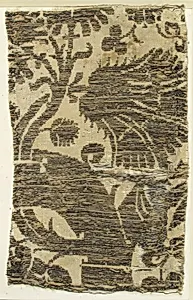
Textile with Brocade
Unknown Artist
14th century
Medium
Silk, gold thread
Dimensions
Overall: 6 5/16 × 4 1/8 in. (16.1 × 10.5 cm) Storage (Mat): 13 × 8 1/2 in. (33 × 21.6 cm)
Classification
Textiles-Woven-Brocade
Culture
Italian
Department
Medieval Art
Museum
Metropolitan Museum of Art, New York, NY
Credit
Rogers Fund, 1909
Accession Number
09.50.1024
Rights
Public Domain
Art Historical Context
This exquisite 14th-century Italiancade textile, woven from luxurious silk and shimmering gold thread offers a glimpse into the opulence of medieval Europe. Measuring just 6 5/16 × 4 18 inches, this small fragment—now housed in the Metropolitan Museum Art's Medieval Art Department—was acquired through the Rogers Fund in 1909. As a product of Italy's renowned textile workshops, exemplifies the era's mastery of woven luxury goods, likely intended for ecclesiastical vestments, noble garments, or decorative panels. Brocade, the textile's classification, is a sophisticated weaving technique where supplementary gold threads are floated over the silk ground to create raised, intricate patterns. This method produced a tactile, jewel-like surface that caught the light, symbolizing wealth and piety. In 14th-century Italy, amid flourishing trade routes from the East, silk brocades like this one highlighted technical innovation and cultural exchange, blending Byzantine influences with emerging Gothic motifs. Though the artist remains unknown, this piece underscores the anonymous yet skilled labor of medieval artisans. Visitors can appreciate how such textiles bridged art and daily splendor, transforming fabric into a canvas of historical narrative.